
What are my options for drawing on super savings?


By Allan McGregor
Financial Adviser
Allan is a dedicated financial adviser who focuses on building strong, lasting relationships with his clients. He takes pride in helping people achieve their goals – whether it’s planning for retirement, or taking a long-awaited holiday.
Retiring well means making a series of decisions to ensure a financially secure post-work life. One practical step is to work out the income you need each week to survive and thrive when you stop working.
If you are one of the many Australians still working and growing your super, knowing more about tailored retirement income products might help to plan.
- There are two main ways to use super savings in retirement:
- through products that provide an income stream, and/or
- through lump sums.
Account-based pensions
The most common product for a retirement income stream in super is an account-based pension. These must be set up in super and there are advantages to having your retirement income inside super. Around 80% of retired super fund members have one or more account-based pensions.
These products offer flexibility, control and continued exposure to investment markets. They allow retirees to convert part, or all, of their super balance into an income stream while keeping an allocated sum invested.
More than one can be set up, at different times, and with different investment choices, so your investment balance keeps growing while providing income in the short-term. Retirees can choose how much they withdraw, as long as they meet the government’s minimum withdrawal requirements.
Arguably, the greatest advantage of an account-based pension within super is its tax effectiveness compared to investments outside super. Once a super member is fully retired, both the investment earnings and income drawn from an account-based pension in super is tax-free.
One of the disadvantages of account-based pensions in super is that the age-based minimum drawdown rates might not suit your investment timing or income preferences. Investment returns are not guaranteed, and you don’t know how many years of income will be needed.
If you die before the funds are fully drawn, however, your beneficiary can receive the remaining money.
Another option for regular income: annuities
Retirees can also use their super to buy another type of income product called an annuity. There are a few main types of annuities and you can choose if you want the income payments:
- guaranteed over a fixed period of time
- investment-linked over a fixed period or for life, or
- guaranteed for the rest of your life, typically adjusted for inflation.
The cost of the annuity will vary depending on these factors. Annuities provide more certainty both in the payments and timeframe for income, regardless of investment market performance.
In Australia, fewer than 5% of super member accounts are annuities. But that may be changing, as more retirees realise the advantages of including an annuity in their super income planning.
Annuities can be bought using super or non-super money, but using super has the advantage of tax-free earnings and income.
In addition, for Age Pension eligibility, Centrelink only takes into consideration 60% of the value of a lifetime annuity compared to 100% of an account-based pension. This favourable treatment means your super savings can last longer, because your retirement income will be supplemented with more Age Pension.
On the downside, annuities have less flexibility. Once you have committed a lump sum of super to purchase the annuity, you cannot easily convert that back into a lump sum or adjust the annual payment amount.
The income from annuity returns may also not be as high as in an account-based pension, because there is a trade-off between investment returns and guaranteed income.
Choosing the right mix for your circumstances
Retirees may benefit from a retirement income strategy that includes a combination of account-based pensions and annuities, depending on their personal needs and circumstances.
Once aged 67, retirees will also be eligible for the Age Pension, within asset or income limits. More than 60% of retirees receive at least some Age Pension, around 40% as their main income.
Main source of income at retirement
The government Age Pension is the most common source of income for retirees, while 30% of retired women relied on their partner’s income to meet their living costs at retirement.
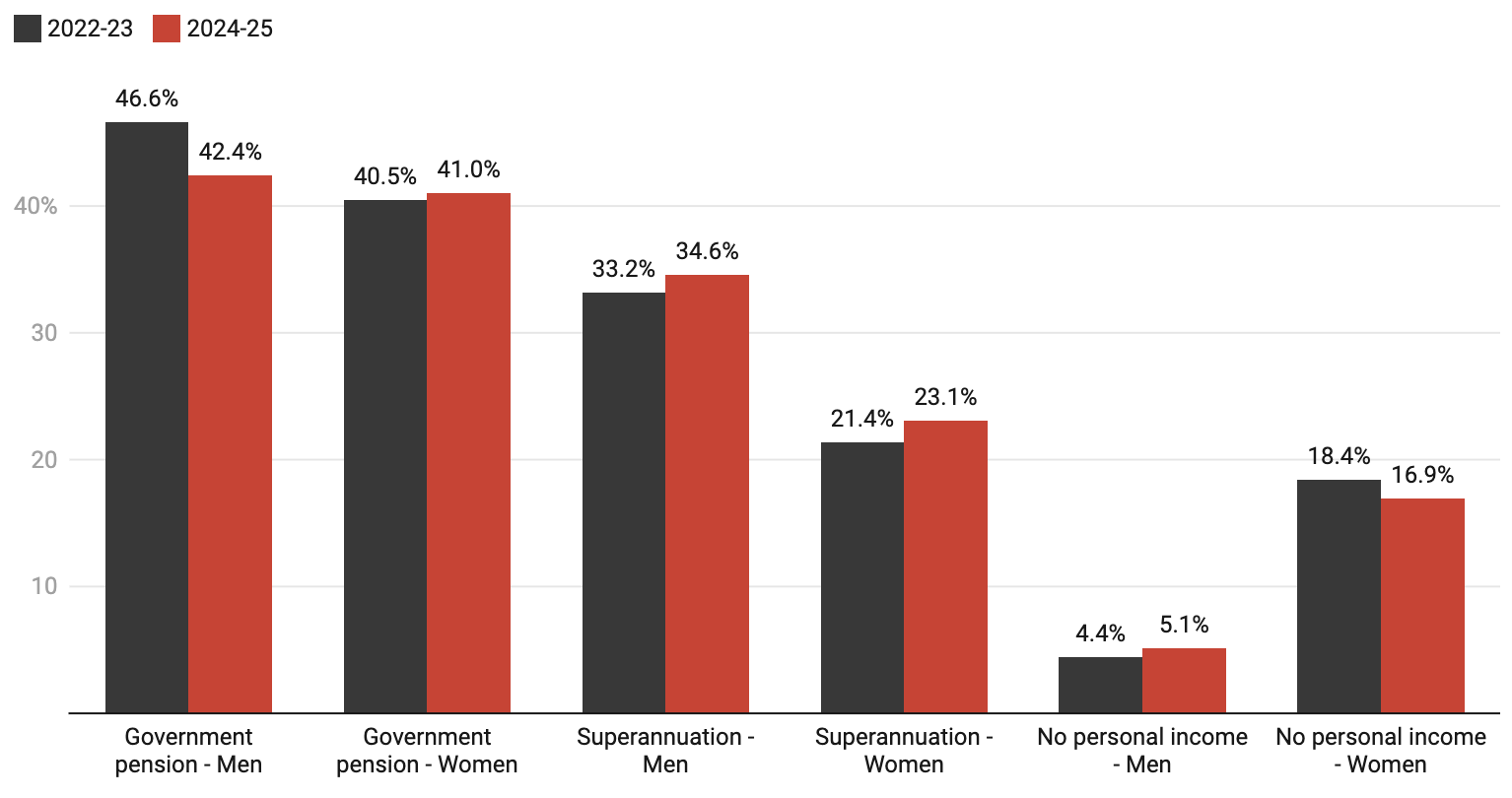
Source: Australian Bureau of Statistics, Retirement and Retirement Intentions, Australia 2024-25 financial year
There is a maximum amount that can be transferred to pension phase within super, regardless of whether you choose an account-based pension or annuity, or a combination. That cap currently sits at A$2 million.
What about lump sums?
Once a super fund member reaches preservation age, usually age 60, and ceases at least one job, they may be able to access some or all their super as a lump sum. Alternatively, a member can access all their super as a lump sum when they turn 65, regardless of their employment.
With more people heading into retirement with mortgages, lump sums can be used to pay down debt, or for home repairs, holidays or even gifting.
How the lump sum is used may affect your age pension. In 2025, the average lump sum taken out by newly retired members was around $58,000.
While income stream products have a range of advantages within super, taking at least some super as a lump sum is common, even later in retirement. More than $71 billion was paid out in lump sums from superannuation in 2025 across 2.26 million member accounts.
Professional financial advice can help
Getting advice on coordinating super income streams and age pension entitlements can make a big difference to maximising your income while managing risk. Financial advice is in high demand, either within or outside your super fund.
Super funds can provide a range of valuable information, calculators and support. Other online tools are also available that can help with retirement income planning, including taking Age Pension eligibility into account.
Planning your retirement income doesn’t have to be overwhelming. Whether you’re considering an account-based pension, an annuity, or a combination of both, getting the right strategy in place can make a significant difference to your financial security. Speak with our team today to explore your options and build a personalised plan that works for you.
Alteris Financial Group Pty Ltd (ABN 59 133 479 115) holder of AFSL No.402370. The information contained in this article is general in nature and does not take into account your personal circumstances. We recommend you consult a financial adviser whose advice will take into account your particular objectives, financial situation and individual needs.
More insights

Downsizer contributions: How to boost your super when you sell your home
Selling the family home usually frees up more money than any other single event in retirement. The downsizer contribution rules let you move a large slice of that money into superannuation, up to $300,000 per person, or $600,000 for a couple, without affecting your normal contribution caps…

Unpacking 1 July 2026 superannuation changes
Superannuation is once again in the spotlight, with a range of changes taking effect from 1 July 2026, further reinforcing its position as one of the most tax‑effective ways to invest. For many investors, it’s not simply that super remains appealing, it’s that the rules continue to evolve…

SMSF changes in 2026: Are you prepared?
Self‑managed superannuation fund (SMSF) trustees often have a great deal on their to‑do lists, but the early months of 2026 are shaping up to be even busier than usual. Several SMSF changes are scheduled to take effect, and preparing early will be essential.